The Future of Science – Jan Hauke Plaßmann
A panel discussion organised by the RG ‘Science Policy’ tackled the issues of contested resources and tenure-track professorships
Photos: Andreas Kämper
Everyone involved in the field of science policy is already looking ahead with great suspense to the year 2020. That’s when the diverse pacts currently being co-financed by the federal and state governments will run out. The goal of the pacts is to meet the demand created by increasing numbers of students in higher education, cover the growing financial requirements in research and development, and generally maintain the quality of academic education in Germany. The year 2020 also marks the end of the European research framework Horizon 2020. The Bundestag must therefore find new means to support the long-term financial prospects of science and research in Germany.
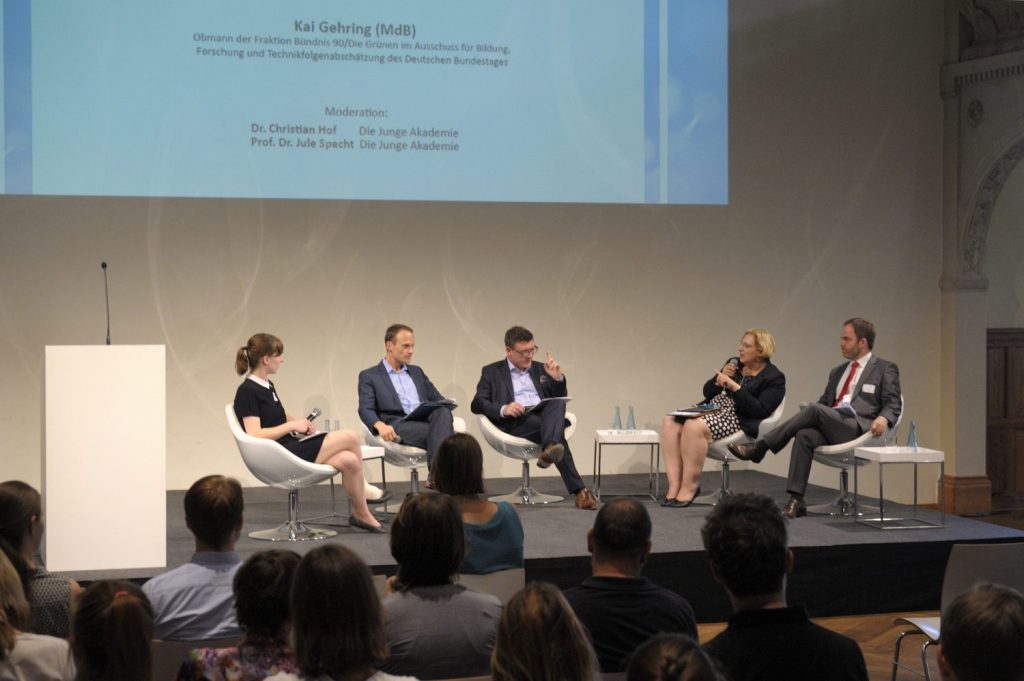
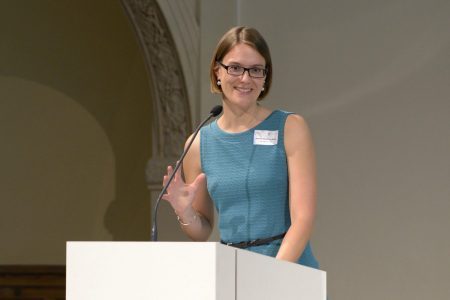
But how should science policy go about tackling these challenges? A panel discussion organised by the RG ‘Science Policy’ in Berlin on 21 June focused on this question. After an introduction by the managing director of the Junge Akademie Marion Schulte zu Berge, a discussion commenced between Jule Specht in her role as speaker of the Junge Akademie, Christian Hof in his role as speaker of the RG ‘Science Policy’, and three experts in the field: Stefan Kaufmann from the CDU, Daniela De Ridder of the Social Democrats and Kai Gehring from the Green party. All three experts are members of the Bundestag Committee for Education, Research, and Technology - Assessment.
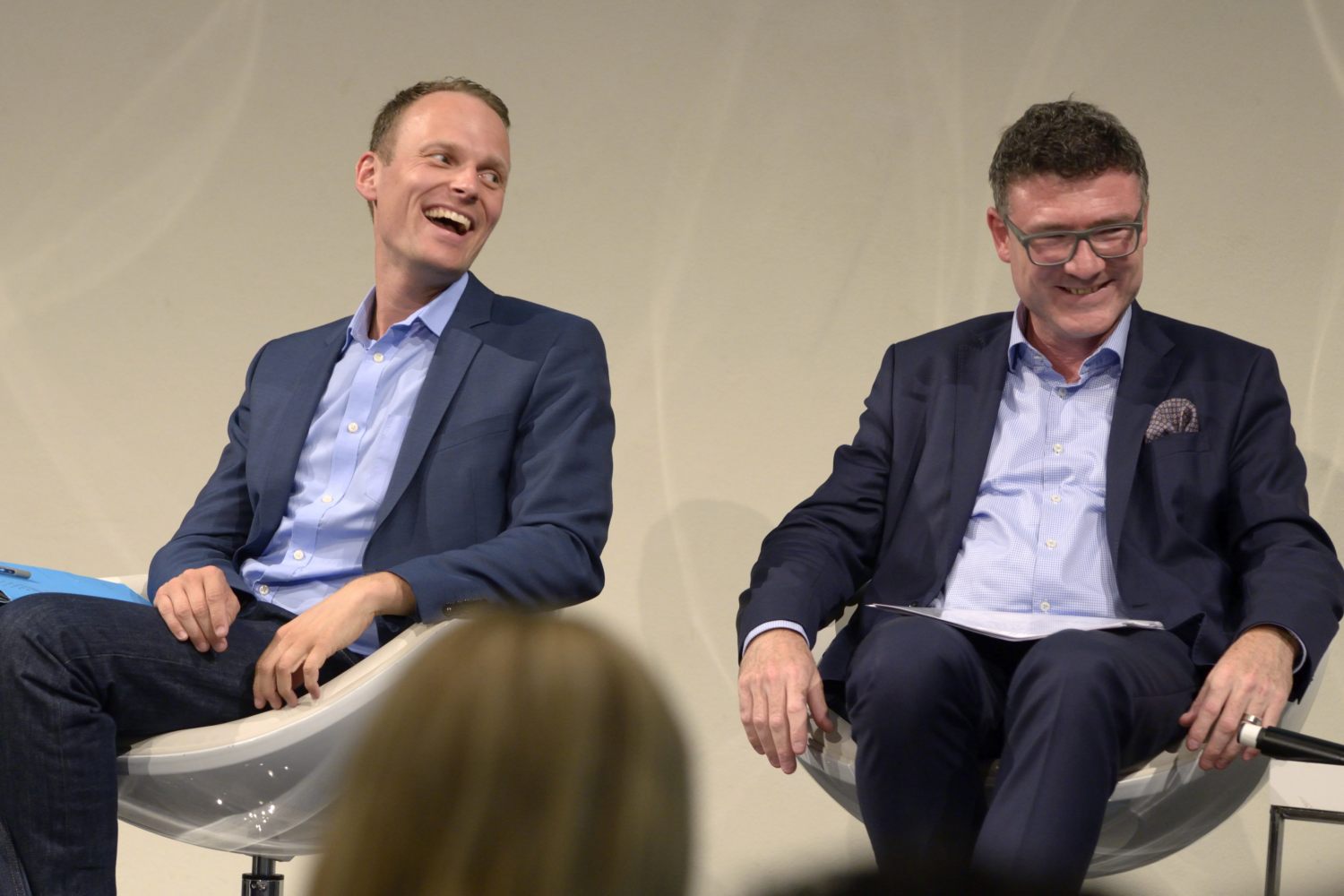
Jule Specht and Christian Hof steered the discussion, with topics ranging from excellence in research and engaging teaching methods to equal opportunity and prospects for early career scientists. The panellists repeatedly pointed to the federal dimension of the complex decision-making process in German science policy and the resulting lengthy duration of approval processes. But no matter how complex an approval process may be, every political initiative requires ideas in order for someone to get the ball rolling.
"When global events require a country to invest in a military build-up, the issue of increasing financing for research and development stops being a priority"
Science policy is not an island and is dependent on framework conditions that lie beyond the influence of any and all participants. This was made particularly clear by events that occurred in the run-up to the panel discussion. On the evening of the discussion, the opposition faction in the Bundestag called a last-minute personal vote on the immediate withdrawal of the Bundeswehr from Incirlik in Turkey, thus delaying the event in the Villa Elisabeth by an hour. This perfectly illustrated what Angela Merkel had previously announced to the scientific community, namely that when global events require a country to invest in a military build-up, the issue of increasing financing for research and development stops being a priority. In other words: science policy takes place against the backdrop of larger-scale political conflicts over financial resources.
The topic of the distribution of limited financial resources was eagerly debated within the brief discussion round. When presented with a question about the structure of the tenure-track program, with its limited reach, sparse funding, and shockingly unequal ratio of a thousand tenure-track professorships to more than a hundred thousand non-professorial teaching staff, Stefan Kaufmann parried by pointing out that ‘there simply weren’t seven billion euros available to pour into this program’. The financial aspects of advancing science and research were repeatedly brought up by the panellists. When asked about the biggest achievement of the last four years, Kaufmann listed, among other things, the fact that the Bund had taken over BAföG (Federal Training Assistance Act) funding, thereby freeing up several billion euros in the budgets of the Länder. But Kaufmann also pointed out that a few of the Länder were not using the newly available money to improve their higher education infrastructure, but rather to consolidate their budgets.
Kai Gehring argued that this was not the case, and explained that the intention had always been for the Länder to use the newly available resources for a variety of purposes, including supporting schools in the form of financial resources and new equipment. The panellists also disagreed when it came to the distribution of federal and state competences. While all three panellists generally welcomed the direction enabled by changes to Article 91b of the Constitution, Daniela De Ridder pointed out that the Länder still required more and longer-term investment from the federal government. In particular, she argued that the basic funding for institutes of higher education should be made a priority within federal policy in order to compensate for reductions required to balance the budgets at the state level.
"Science policy often takes place outside of the parliamentary context."
Kai Gehring also spoke out in favour of far-reaching reform that would lead to a highly successful distribution of responsibilities between the federal and state governments – a ‘pact of pacts’. Currently, every project supported with federal funding must be approved by all 16 Länder, thus in a sense giving each state a veto right. Gehring instead suggested a reform whereby a quorum of three-quarters of the Länder, which suffices to change the constitution, would make it possible for Länder governments to approve concrete and long-term projects between themselves and the federal government. This would allow the Länder and the federal government to carry out long overdue investments in construction projects in the higher education and research sector as well as long neglected infrastructure projects.
Throughout the discussion, the panellists emphasised that science policy often takes place outside of the parliamentary context. All three politicians explained that the federal order in education and science policy often leads to the details of pacts and laws being negotiated not in parliamentary sessions, but in ministerial working groups such as the Gemeinsame Wissenschaftskonferenz (Joint Science Conference; GWK). As a result, individual members of parliament have limited opportunities to turn their own ideas and concepts into reality.
"The future of science policy still holds many under-researched areas and surprising developments"
The panellists also covered topics that all participants agreed would need to be dealt with more intensively over the next few years. For instance, the issue of the extremely high number of fixed-term employment contracts among non-professorial staff at universities will become a major focal point for science-political initiatives, while the extension of projects currently being co-financed by the federal and state governments would remain a major concern for all politicians. De Ridder and Kaufmann both highlighted that the topic of professional development and advancement of staff at universities of applied sciences would increase in importance in negotiations between the federal and state governments. Kai Gehring also promised to take on the responsibility borne by the federal government for the entire German academic system in regard to initiating a ‘real’ reform of the Wissenschaftszeitvertragsgesetz (Academic Fixed-Term Contract Law).
The panellists were unexpectedly unanimous in their answers to the final question of the discussion. Host Jule Specht asked whether they thought the current principle of professorships would still exist at universities 30 years from now. Stefan Kaufmann, Daniela De Ridder and Kai Gehring all answered in rare agreement: no. The future of science policy still holds many under-researched areas and surprising developments, and is simultaneously subject to global influences that may have an impact on the resources available for research and education. With the encouragement of the panellists, the Junge Akademie will continue to work to add new insights to the debates within science policy.
Jan Hauke Plaßmann has been Academic Coordinator at the Junge Akademie.


